Dear HER-Health: Where Did My Estrogen Go?
Written by: Heather Florio

Dear HER-Health,
I’ve been on the estradiol patch for a little over two years, and honestly, it gave me my life back. I sleep through the night, the hot flashes stopped, and the brain fog that made me feel like a stranger to myself finally lifted. Last month, my pharmacy told me my patch was “backordered” with no refill date. I’ve since called five different pharmacies and heard the same thing at every one. When I went looking for an explanation, I found that the FDA says there’s no shortage, which made me feel like I was losing my mind. Am I imagining this? Is my medication just… gone? And what on earth am I supposed to do now?
— Running on Empty in Ohio
Dear Running on Empty,
First, the two things I most want you to hear: you are not imagining this, and you are not alone. Women in every corner of the country are standing exactly where you are, and the gap between the official story and your empty-handed trip to the pharmacy is not a sign that you've lost the thread. It's a sign you've been handed the wrong explanation, and you deserve the real one.
The story you'll hear everywhere is that this is a shortage of our own making: so many women suddenly wanting hormone therapy that supply simply couldn't keep up. I want to push back on that, hard, because it quietly turns a system's failure into women's fault, and it doesn't hold up.
Yes, more of us are being treated than a few years ago. Prescription data shows hormone therapy use up roughly 72% since 2021, and estrogen patch prescriptions specifically up well over 150% in just two years. But here's what that framing leaves out: none of this was a surprise. The menopause conversation has been building loudly for years; in the research reexamining the overstated 2002 cancer scare, in the doctors and advocates who spent a decade coaxing women back toward safe, effective care, across every menopause account and physician's feed online. And when the FDA finally lifted the decades-old black box warning from hormone therapy last November, the rise that followed wasn't a shock. It was the single most predictable outcome imaginable. Manufacturers plan their production months ahead; they could see this coming from a mile away. "We couldn't keep up with demand" is not an act of God, it's a description of a system that chose not to prepare for the women it knew were on their way.
And the cost of that choice is not abstract. In one survey of nearly 8,000 women, 44% reported trouble filling their estrogen patch prescriptions, and a third of those said it meaningfully harmed their wellbeing. That isn't inconvenience. That's hot flashes, sleepless nights, brain fog, and anxiety roaring back for hundreds of thousands of women, while the official word stays fixed at "no shortage."
Which brings me to the thing I can't stop turning over. Estradiol isn't new or exotic. The patch has existed for decades, it's made by several generic manufacturers, and it's cheap. So ask yourself this: when was the last time you heard of a months-long, coast-to-coast shortage of a medication men depend on — one the FDA wouldn't even formally acknowledge while men stood at empty counters? I'll wait. When a treatment is essential to men, its supply is treated as essential. When it's essential to women, and to menopausal women especially, whom this culture has always been a little too willing to wave off, the very same disruption gets absorbed, shrugged at, and quietly relabeled a "surge in demand." That contrast is the tell. This was never a story about women asking for too much. It's a story about whose needs get planned for, and whose get improvised around.
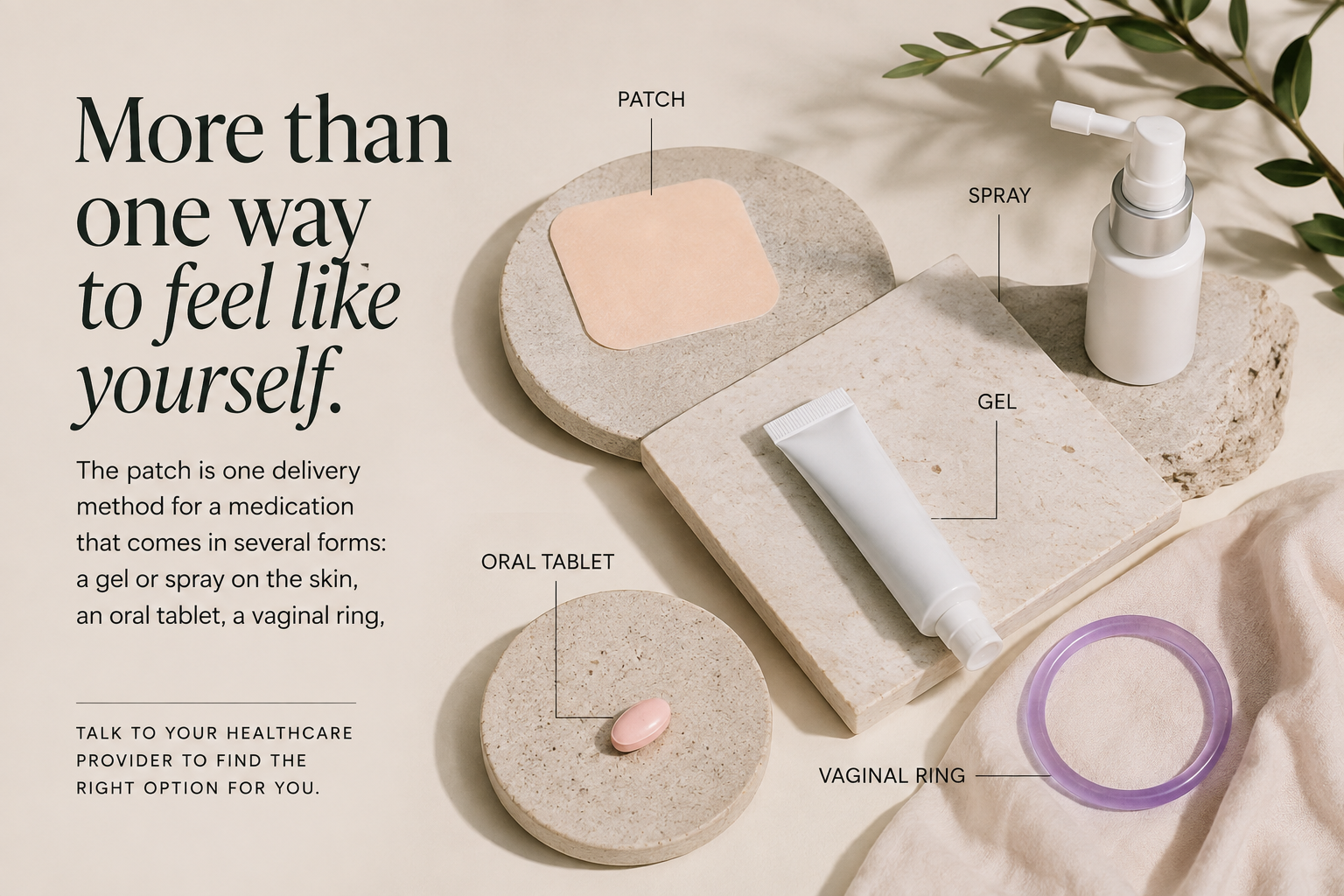
None of this, though, means you have to go without estrogen, and this is the part I most want you to hold onto. The patch is one delivery method for a medication that comes in several forms: a gel or spray on the skin, an oral tablet, a vaginal ring, and, in some cases, a compounded preparation. Which one is right for you depends on your body, your symptoms, your history, and your provider's judgment. So it's a conversation to have with them, not a decision to make from a pharmacy line or a search bar. I won't rank them for you; you don't need another chart telling you what's "best." You simply need to know the options are real, and that a good clinician can help you find the one that fits your life.
If your refill comes up empty this week, a few concrete moves. Don't simply go without, and don't improvise a substitute on your own. Call your prescriber first and ask directly what else you can use. Widen your search: independent pharmacies, mail-order and specialty pharmacies, and different strengths or brands than your usual one can all turn up stock your corner drugstore doesn't have. Call ahead across a broader radius, since supply is wildly inconsistent from region to region. And ask your provider whether a compounding pharmacy could bridge the gap, using the same regulated ingredients, when commercial products are hard to find.
I'll be honest about why this lands so hard for me. For two decades, women were told their symptoms were exaggerated, their treatment dangerous, their discomfort simply the price of getting older. We fought our way back to care that works, and the moment we did, the shelves went bare and the paperwork insisted nothing was wrong. That is not a coincidence you should be asked to swallow quietly, and the answer is emphatically not for women to lower their expectations. Your symptoms are real, your options are real, and what you're living through is not a personal inconvenience to bear gracefully. It's a systemic failure you have every right to name.
And here's one more concrete thing you can do, one that turns your frustration into something the system has to reckon with. Part of why the FDA can claim this doesn't meet its bar for an "official" shortage comes down to how supply data reaches the agency. So make your reality part of that record. You can report a shortage or supply problem directly to the FDA's drug shortage program by emailing drugshortages@fda.hhs.gov (or calling 240-402-7770), and if the estradiol patch still isn't listed in the FDA's Drug Shortages Database, you can file it as a new shortage through the public reporting portal on the agency's drug shortages page. Every empty-handed trip to the pharmacy that lands in that inbox is one more data point the official story can no longer wave away. And because the deeper fix is a legislative one, send a short note to your members of Congress too: tell them a safe, inexpensive medication that women rely on keeps vanishing from shelves, and that you expect them to ask why.